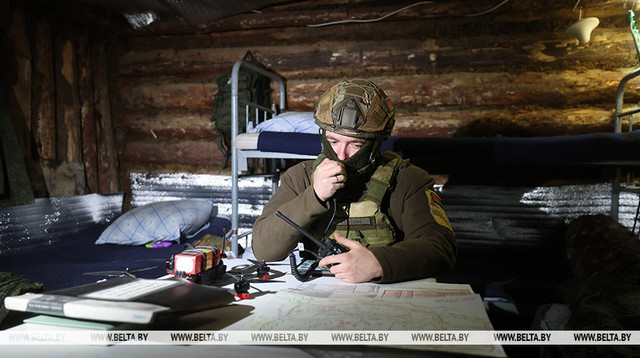
Viktor Tumar, Deputy Chief for Research of the General Staff of the Armed Forces, commented on the ongoing inspection of the combat readiness of Belarus’ Armed Forces in a new episode of BelTA’s project The Nation Speaks.
A large-scale inspection of the Armed Forces, ordered by the president of Belarus, began on 16 January. Aleksandr Lukashenko maintains personal oversight of the inspection’s progress. A new system has been implemented that allows the president to directly place military units on combat readiness, circumventing the Ministry of Defense and the General Staff.
According to Viktor Tumar, the checks are unexpected for commanders. “They are not informed in advance. Instead, they are simply handed a sealed envelope. Inside, there is an order from the Commander-in-Chief, the Defense Minister, or a Commander. This is a normal annual practice. This time, mechanized units and special operations forces were inspected,” he noted. “The head of state decided to test units of permanent readiness. At the signal, they must immediately deploy and carry out their mission.”
According to him, the units practiced the full range of tasks. “They carried out a march while repelling attacks by sabotage and reconnaissance groups or illegal armed formations. They conducted live-fire exercises with all types of weapons and completed combat missions. Afterwards, they returned to their permanent bases,” Viktor Tumar said.
According to the defense minister’s plan, reservists are now being called up and assigned to the designated unit. “The goal is to mobilize the reserve potential and restore the skills of those who previously served in the Armed Forces, so they are prepared,” Viktor Tumar explained.
Commanders are also conducting checks of specific tasks. “This may include a march, removing equipment from storage and putting it into service, or exercises at a training ground,” the deputy chief added.
He stressed that the main difference in the Commander-in-Chief’s snap inspection is that the conditions are as close to combat as possible. “"The element of surprise remains the same in all cases, but the activities are different. According to the [defense] ministry's plan, they involve mobilization and combat tasks. According to the Commander-in-Chief’s plan – combat tasks for permanent-readiness units. These units are always ready. They do not need to replenish ammunition or fuel supplies. They must immediately move to the area and complete the mission. Therefore, the General Staff or Ministry of Defense does not need to manage, staff, or assist the unit. It acts autonomously,” he explained.
The president is reviewing precisely these units, which are capable of operating independently. According to the Defense Minister's plan, the entire system is involved, including military commissariats and logistics. “It is a complete cycle from start to finish. Once the unit is staffed and has undergone combat coordination, it carries out combat missions – just as units do under the Commander-in-Chief’s plan,” Viktor Tumar concluded.