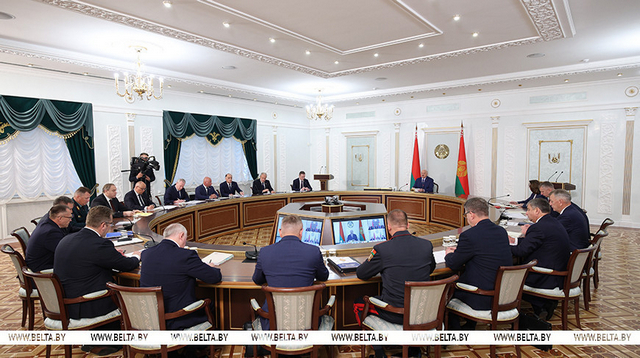
Belarusian President Aleksandr Lukashenko outlined the key conditions for a successful harvest campaign during a nationwide video conference to discuss the 2026 harvest campaign on 21 July, BelTA has learned.
The head of state noted that fieldwork is currently progressing on multiple fronts simultaneously. Harvesting of grains and winter rapeseed is underway, along with the second cut of grasses, and sowing of winter crops will soon follow. “Proper planning across all levels is the task of the entire chain - from agronomists and farm directors to governors and the prime minister,” Aleksandr Lukashenko emphasized.
According to government data, the projected gross grain harvest is expected to exceed 11 million tonnes, matching last year’s level. “This year we must definitely surpass that result. We agreed with you that last year’s level is the benchmark we will always use as our reference point. As I’m being briefed, grain yields in most regions will be no worse than last year. Compared to 2025, corn development may be about two weeks behind,” Aleksandr Lukashenko cautioned.
The president observed that thoughtful crop rotation and a well-designed structure of sown areas have enabled agricultural producers to spread the harvest workload over roughly three to three and a half months. In this regard, the president laid out the key conditions that will determine the success of the current harvest effort.
On equipment readiness and personnel
“Harvesters, tractors, and grain drying facilities must all be in proper working order, with qualified personnel assigned to every piece of equipment,” the head of state emphasized.
According to government estimates, equipment readiness stands at 99%, which is higher than last year. The president noted that this is sufficient for a full-scale harvest. Agricultural organizations across the country have 6,800 grain harvesters at their disposal, and an additional 400 new harvesters will be deployed for the campaign.
“At the same time, not everything is as rosy as we would like it to be. As of 14 July, the State Control Committee had identified instances of low harvester readiness in 36 out of 146 agricultural organizations inspected. In some farms in Verkhnedvinsk District, Shumilino District, Kalinkovichi District, Smorgon District, Oshmyany District, Bykhov District, and Krichev District, repair work only began on the eve of the harvest,” the Belarusian leader said.
As the president has been briefed, the staffing shortage at the organizational level has mostly been sorted out. “We’ve brought in an extra 2,331 workers for the harvest. That said, as of 13 July, not everyone had shown up at the farms. In Vitebsk Oblast, for instance, only 485 out of the 655 machine operators needed were actually on site,” he remarked.
He stated that the pace of harvesting and the minimization of grain losses depend directly on the availability of fuel on farms: “I would like to hear how things stand with fuel reserves on the ground.”
On the reliability of drying facilities
“The key to a successful campaign this year, in particular, is the reliability of drying infrastructure. Large volumes of grain will have to be passed through dryers, at least once, to avoid crop losses. Therefore, all grain receiving and drying facilities must be in full working order,” the president instructed.
Aleksandr Lukashenko noted that the current readiness of grain drying complexes stands at 97%. According to government data, the existing 1,660 grain dryers are sufficient to process the daily volume of grain. “That may be the view from the government’s offices, but the reality on the ground is different. Flying over the eastern and central parts of Belarus, I saw plenty of grain sitting in open piles at the receiving stations,” the Belarusian leader said.
“I hope you fully understand that a grain dryer going down means the entire harvest cycle grinding to a halt, widespread crop spoilage, and a downgrade in grain quality,” the head of state emphasized.
The president noted that inspectors had found grain dryers to be unprepared in one out of every five farms. Just last week, 49 dryers were out of service, including 16 in Vitebsk Oblast and 13 in Gomel Oblast.
“Moreover, in several districts, this was the only dryer available. For example, in Gomel Oblast, 15 out of 88 grain cleaning and drying complexes had not obtained permits for natural gas use. We’ve barely started harvesting, and we’re already seeing above-standard losses and mismanagement of grain during reaping, transportation, and processing. This is unacceptable. Such cases have been identified in farms in Zhabinka District , Zelva District, Lelchitsy District, Pukhovichi District, and Chausy District,” said Aleksandr Lukashenko.
FM发射器和频率:
布列斯特:106.2兆赫
格罗德诺:95.7兆赫
斯维斯洛奇:104.4兆赫
杰拉纽讷:99.9兆赫
布拉斯拉夫:106.6兆赫
米亚德利:102.0兆赫
征文活动