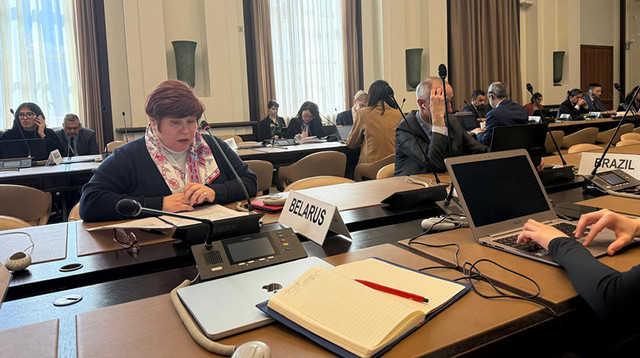
Belarus is committed to building a world free of nuclear weapons and advocates strict compliance with the Nuclear Non-Proliferation Treaty (NPT), Permanent Representative of the Republic of Belarus to the United Nations Office and other international organizations in Geneva Larisa Belskaya said during a plenary meeting of the UN Conference on Disarmament, BelTA learned from Belarus’ Permanent Mission to the UN Office in Geneva.
Larisa Belskaya noted: “At one point, Belarus renounced its nuclear arsenal, joined the NPT as a non-nuclear state, and received guarantees. These guarantees included, in addition to negative security assurances, respect for sovereignty, and the renunciation of threats of force and economic coercion.”
“Nevertheless, in addition to large-scale economic sanctions and political pressure on the Belarusian state, we have witnessed accelerated militarization along our western borders for several years. Attempts to draw Belarus into an open armed conflict are increasing. At the same time, Minsk has consistently called on its western neighbors to engage in professional, depoliticized military dialogue. The response has been silence,” Larisa Belskaya said.
She stressed that an impartial look at the figures reveals a worrying trend. “The European Union has approved the Readiness 2030 roadmap aiming to mobilize up to €800 billion in defense spending by 2030. This represents more than a threefold increase in spending on combat aviation, drones, heavy armored vehicles, the expansion of military production, and more,” she said.
Larisa Belskaya cited additional figures: “In three neighboring western countries (Poland, Lithuania, and Latvia) combined military spending exceeded €52 billion in 2025. This is 25 times more than Belarus spends on defense. Our neighbors are withdrawing from the Anti-Personnel Mine Ban Convention and deploying missile defense systems technically capable of launching Tomahawk missiles. The threat of an attack on Belarus using conventional forces and precision weapons is growing.”
“As the Belarusian president has noted, when reliable contractual foundations of security disappear and confidence-building measures cease to function, the role of deterrence tools, including nuclear deterrence, increases. Amid a critical transformation of the security landscape near our borders, Belarus is compelled to take additional measures,” she stated.
“The nuclear umbrella provided by Russia within the framework of positive security guarantees under the Union State and the deployment of Russian tactical nuclear weapons in Belarus are not instruments of aggression, but strictly defensive measures and an element of strategic deterrence,” the diplomat said. “The deployment of tactical nuclear weapons in Belarus is intended to reduce escalation options at the pre-nuclear level and prevent aggression posing a critical threat to our country’s sovereignty.”
She also emphasized that Belarus-Russia cooperation in the nuclear sphere is fully consistent with international law and, above all, with the NPT regime.
Larisa Belskaya noted that Europe is currently debating ‘forward deterrence’ based on French nuclear forces or, as some Western politicians put it, ‘European nuclear power.’ At least six European countries have expressed readiness to host allied nuclear weapons on their territory.
“This confirms the growing threat of potential nuclear confrontation in Europe. To the best of its ability, Belarus is prepared to contribute to preventing such an outcome. Security guarantees do not exist alone. They must form part of joint efforts, primarily by nuclear powers, to reduce interstate tensions, as well as collective efforts to build a system of common and indivisible security at both regional and global levels,” she concluded.
“Belarus remains committed to effective security guarantees for non-nuclear-weapon states against the use or threat of use of nuclear weapons. We also support the idea of developing, in the future, a legally binding agreement on security guarantees for non-nuclear states. Arrangements on such guarantees and their implementation should address the key risk factors that increase the likelihood of nuclear conflict. Belarus stands ready to work in this area with all interested states,” Larisa Belskaya said.