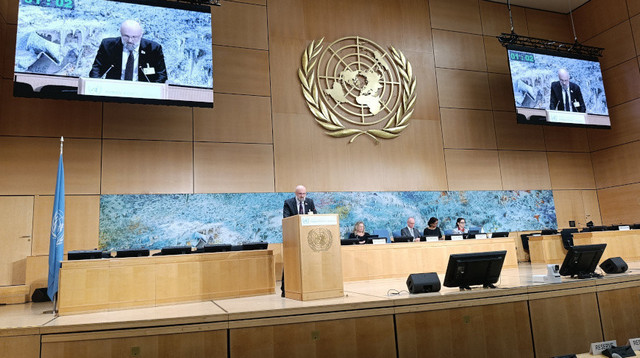
The work of the UN Human Rights Council is increasingly failing, turning into a farce, Belarusian Deputy Minister of Foreign Affairs Igor Sekreta said at the high-level segment of the 61st session of the UN Human Rights Council in Geneva, BelTA has learned.
The Belarusian diplomat recalled that this year, 2026, is significant for the international human rights system. This year marks the 60th anniversary of the two Covenants (on Civil and Political Rights, and on Economic, Social and Cultural Rights), which form the basis of the International Bill of Human Rights. It also marks the 20th anniversary of the UN Human Rights Council, which replaced the Commission on Human Rights.
“Belarus was against such radical transformations and proposed 'fixing' the commission. It turned out to be right. But, as they say, it is always easier to break than to build. These are good occasions to assess progress in the field of human rights. Unfortunately, there is not much to brag about. The paradox is that all the mechanisms for work are in place, but there is no result. Today's speeches prove that the work of the UNHRC is increasingly failing, turning into a farce,” Igor Sekreta stated.
He noted that the majority of states are increasingly growing unhappy about this organization. The only ones satisfied with the UN Human Rights Council are those who are trying to impose their own recipe for 'democracy' through it, which in reality turns into chaos and anti-constitutional disorder for other sovereign countries.
“The resolutions adopted in this hall, alas, are not about human rights at all. They serve completely different purposes: justifying sanctions, external pressure, lynching inconvenient governments, dividing the world into 'bad' and 'good'. Special rapporteurs and so-called independent experts have assumed the role of quasi-investigative and quasi-judicial bodies: they directly interfere in the internal affairs of sovereign states. The question is: on what basis? Why are some countries examined under a magnifying glass, while others find themselves in the 'blind spot' of the Council? After all, there are no ideal countries, as the universal periodic review show,” the deputy minister noted.
He emphasized that all states must be subject to the same laws. However, international mechanisms have still not obliged, for example, Latvia to eliminate the institution of statelessness.
“Stateless persons continue to live there by the grace of the Latvian government, which is a member of the EU. At the same time, national minorities in Latvia are universally oppressed, deprived of the right to work and an adequate standard of living. The inhumane treatment by Lithuania and Poland of migrants and refugees striving to get into Europe on the border of Belarus and the EU has never become a subject of condemnation by the UNHRC. And what does the Council think about the ban in these countries on the activities of journalists and media outlets broadcasting alternative points of view? These are vivid examples of the selectivity that defines the work of this body. The human rights treaty bodies operate according to the same scenario," the diplomat noted.
As another example, he cited the use of unilateral coercive measures. According to Igor Sekreta, such practice defies all logic from the point of view of human rights. Sanctions affect not only the citizens of the affected states, but also, paradoxically, the citizens of the countries that initiate such illegal sanctions.
“This year provides a very telling example. While residents of supposedly prosperous Europe are forced to save on heating, yet still pay exorbitant, huge electricity bills due to the cold winter this year, Belarus, despite unprecedented illegal sanctions pressure, guided by the interests of its citizens, is postponing the scheduled increase in utility tariffs during the cold period. The state is consciously taking on the financial burden to protect families, pensioners, ordinary people – the vulnerable groups of the population,” the Belarusian diplomat said.
So while Europe is paying for political miscalculations with rising prices and a declining standard of living, Belarus’ priorities remain unchanged: stability, social protection, and support for its citizens. “This clearly demonstrates the difference in approaches and the difference in values that are being discussed so much in this hall these days. It is no secret that the UN is currently in a challenging situation. A contradictory and divisive human rights agenda has become the main reason for this state of affairs in our organization. Not reduced funding, not the actions of individual states, including the United States, but precisely this divisive human rights agenda. Because this area, more than any other, is full of costly and useless mandates,” Igor Sekreta stressed.
The Belarusian diplomat urged forum participants to honestly acknowledge that further spending of the UN budget on mechanisms that do not deliver practical results cannot be justified politically, financially, or morally.
“Today, states are once again being forced into a global reform accompanied by cuts, optimization, liquidation, and so on, in the hope that this will help us restore efficiency, including in our body here, the Human Rights Council. But reform also costs money! And, as a rule, in the pursuit of optimization, the most important areas suffer: development matters, social projects, support for vulnerable groups (children, the elderly, people with disabilities). The truth is that no institutional changes, cuts, or optimizations will yield results unless the main systemic problem is addressed. And that problem lies not in the formal structure or status of the Council, but in how states use this body and what agenda they bring to it,” the deputy minister said.
According to him, as long as countries bring their bilateral disagreements and geopolitical disputes into the international human rights agenda, often hiding behind it, and Council members themselves undermine the principles of impartiality and cooperation, the situation will not improve.
“The Human Rights Council does not need minor changes, but a return of all states to the basic principles. Let me remind you: respect for the sovereign equality of states, rejection of interference in internal affairs, and rejection of the use of human rights as a tool of pressure. Only under these conditions will the Council be able to preserve its legitimacy in the international system of protecting and promoting human rights,” Igor Sekreta emphasized.
He added that modern Belarus is a stable state firmly following the path of sustainable development. The country proceeds from a simple principle: human rights begin with the right to live with dignity, under a peaceful sky, to receive quality education, decent wages, highly qualified medical care, and social support. And most importantly, to be confident in tomorrow for oneself and one’s children.
“This year has been declared the Year of Women in Belarus, which will strengthen the role of women in the sustainable development of society. This is exactly what Ms. Baerbock spoke about at the opening of our session. We are already working on this. The experience of Belarusians, who today are more united than ever, shows that no sanctions can stop a country that is confidently moving toward its goals and building a future focused on progress, stability, and the well-being of its citizens. We will continue to contribute to ensuring a safe and fair world. We call on everyone not to neglect the potential of dialogue. After all, it is so simple,” the diplomat concluded.